Is AI a Real Substitute for Therapy?
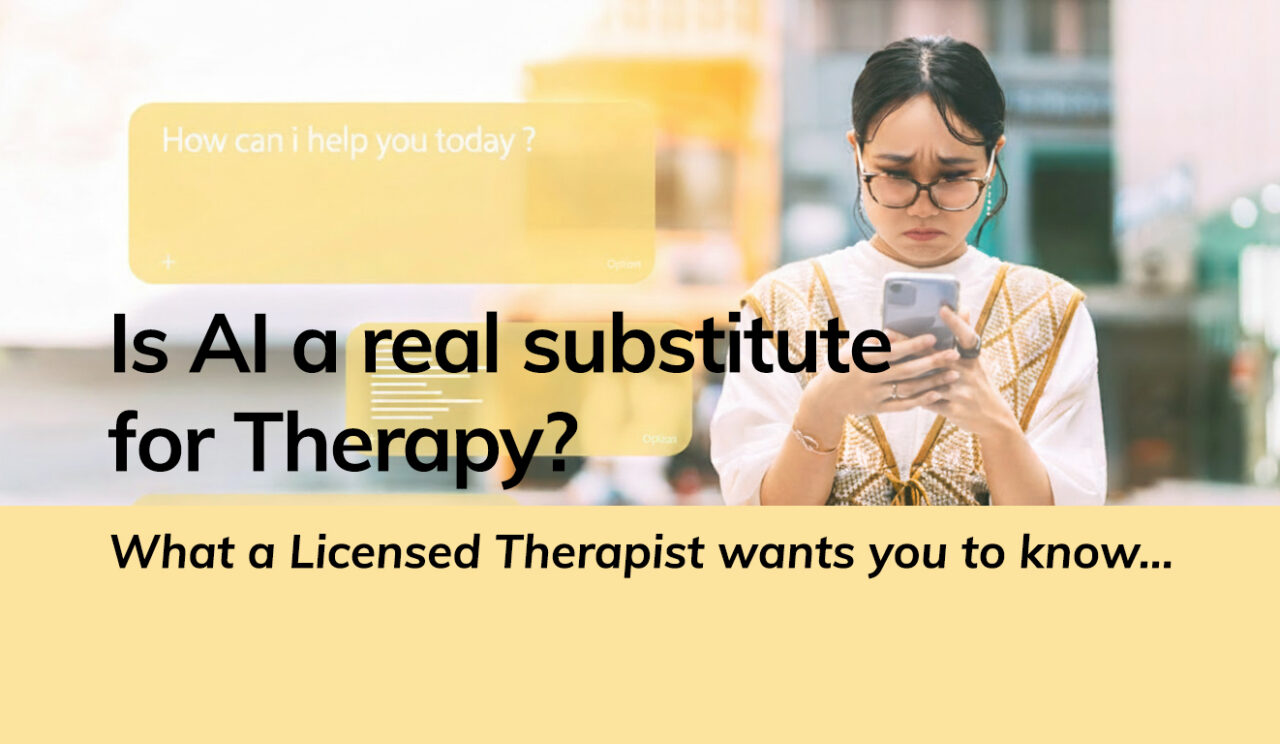
What a Licensed Therapist Wants You to Know
It’s 1am, you can’t sleep, your chest is tight, and the last thing you want to do is wait until Monday to call anyone. So you open an app, type out what’s bothering you, and a chatbot answers in seconds. No waitlist. No copay. No judgment.
It’s easy to see the appeal. AI mental health tools have gone from novelty to mainstream in a couple of years, and millions of people now use them for exactly these moments. The honest question isn’t whether they’re popular. It’s whether they’re doing the job you actually need done.
As a practice that provides online therapy across New York and New Jersey, we get asked some version of this constantly: Do I even need a real therapist if I can just talk to an app? Here’s a straight answer.
What AI chatbots are genuinely good at
We’re not going to pretend these tools are useless. They’re not. For certain things, they’re surprisingly helpful:
- Availability. A chatbot is there at 2am when nobody else is. For a racing mind that just needs to get thoughts out of your head, that has real value.
- Low-stakes reframing. If you’re spiraling on a single worried thought, a well-built tool can walk you through a basic cognitive reframe and help you calm down in the moment.
- Practice and journaling. Some people use them to rehearse a hard conversation or to keep a running log of moods. That’s legitimate.
- Zero embarrassment. If stigma has kept you from talking to anyone at all, typing to a bot can be a first step toward opening up.
If a free app helps you sleep tonight, use it tonight. We mean that. But know what it can’t do.
Where AI stops, and a person has to take over
A chatbot is a pattern-matching tool trained to produce text that sounds supportive. That’s a different thing from care. Here’s where the gap shows up.
It has no clinical judgment. A licensed therapist is trained to notice what you aren’t saying, to spot when “I’m just stressed” is actually depression, and to recognize when symptoms point to something that needs a different kind of help. A chatbot takes your words at face value. It can’t read your tone, your pauses, or your face on a video call.
It will often just agree with you. This is the quiet danger. These tools are built to be agreeable and validating. That feels nice, but real therapy sometimes means being gently challenged on a story you’re telling yourself. A bot that mirrors your thinking back to you can accidentally reinforce the exact patterns keeping you stuck.
It has no accountability. Your therapist is licensed by the state, bound by confidentiality law, carries malpractice responsibility, and answers to a board. An app answers to its terms of service. If something goes wrong, those are not the same level of protection.
It can’t handle a crisis. This is the big one. If you’re having thoughts of harming yourself, an app is not equipped to keep you safe. A trained clinician is. If you are ever in that place, please contact the 988 Suicide and Crisis Lifeline (call or text 988) or go to your nearest emergency room. A chatbot is not a safety plan.
Your privacy may not be what you think. When you tell a therapist something, it’s protected health information. When you type it into a consumer app, it may be data. Read who actually owns and can use what you share before you treat a chatbot like a confidant.
The real comparison isn’t “app vs. driving across town”
A lot of people reach for an AI tool because the alternative feels like a hassle: find a therapist, get on a waitlist, take time off, sit in traffic, sit in a waiting room. That comparison is outdated.
Online therapy removes almost all of that friction. You talk to a real, licensed clinician from the same couch where you’d open the app, at a time that fits your schedule, with the same privacy you’d expect from any medical appointment. You get the convenience that makes chatbots attractive and the clinical judgment, accountability, and genuine relationship that they can’t offer.
The choice was never “convenient app” versus “inconvenient human.” It’s “a tool that sounds like it’s listening” versus “a person who actually is.”
When to stop typing to a bot and talk to someone
Consider reaching out to a licensed therapist if:
- The same worries keep coming back no matter how many times you talk them through with an app.
- Your sleep, appetite, work, or relationships are taking a hit.
- You’re using the chatbot more and more and feeling better less and less.
- Anything in your life feels bigger than a single bad night.
We’re licensed, human, and online across NY and NJ
BCS provides online therapy to people throughout New York and New Jersey. You get a real licensed clinician, the convenience of meeting from home, and care that’s accountable in ways an app will never be.
If you’ve been leaning on an app and it isn’t enough anymore, that’s worth paying attention to, reach to get matched with a therapist.
New Appointments: 718 313 4357