
The loneliness loop: when AI feels easier than people
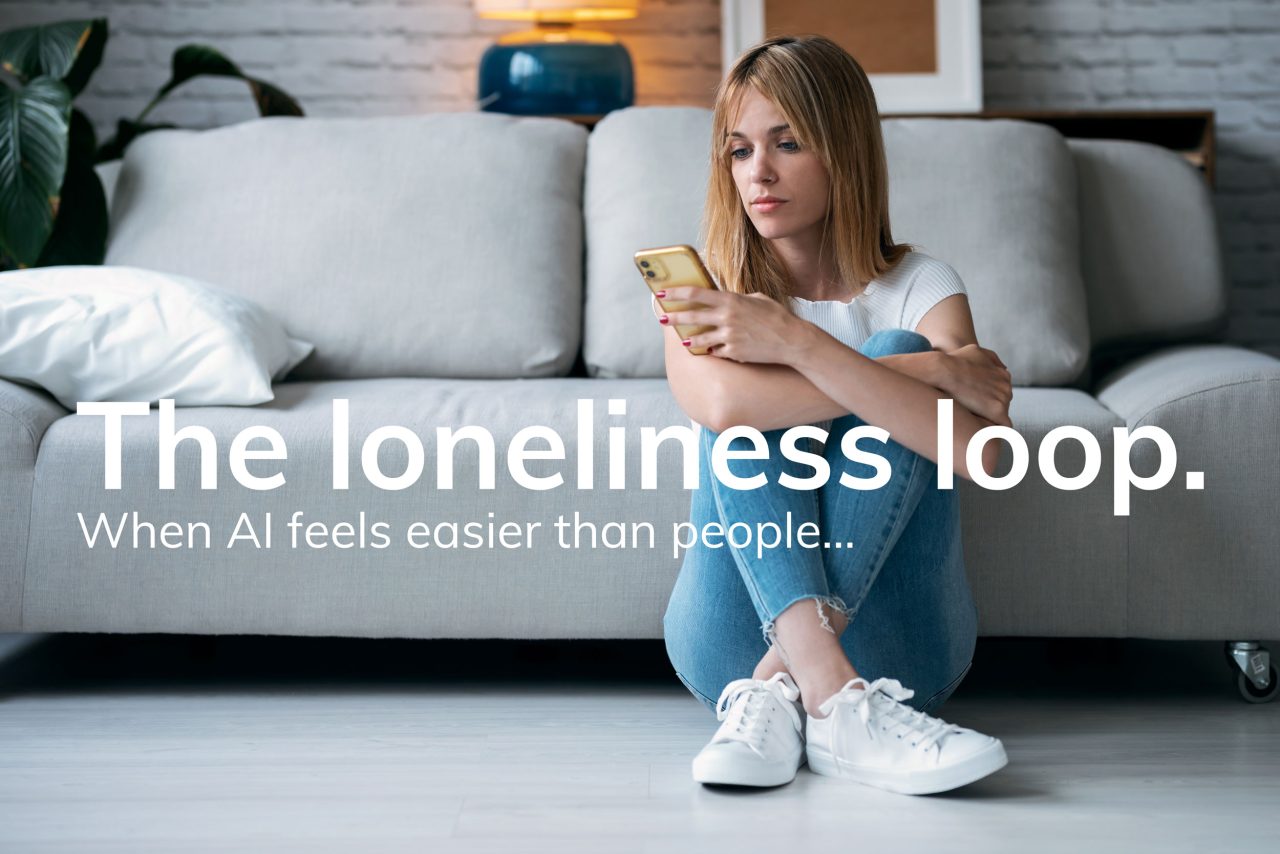
The loneliness loop: when AI feels easier than people
It’s 2am and you can’t sleep. Something’s been sitting on your chest all week: a fight with a friend, a spiral about work, a feeling you can’t name. So you open a chatbot and start typing. It answers instantly. It never judges, never gets tired of you, never looks at its watch.
If that sounds familiar, you’re in good company. In a 2026 survey by the American Psychological Association, most psychologists said they now have patients who use AI for emotional support. Among teens, about one in three say they’d rather have a serious conversation with AI than with a person.
There’s a reason this feels good. And there’s a reason it can quietly make things worse.
Why AI feels easier
Talking to a chatbot removes almost everything that makes opening up hard. There’s no fear of being “too much.” No worrying about how the other person will react. No cost, no waitlist, no scheduling. It’s available at 3am, exactly when hard feelings tend to show up.
None of that makes you weak or antisocial. It makes you human. Wanting to be heard without being judged is one of the most basic needs there is. AI just happens to be the first tool in history that imitates that experience on demand.
What the loneliness loop is
Here’s the catch that therapists are starting to see. A chatbot offers the appearance of connection, with attention, warmth, and instant replies, but without the substance of it. It can’t actually know you. It can’t sit with you. It tells you what tends to sound supportive, not what’s true about your life.
So the conversation feels good in the moment, but the underlying loneliness doesn’t move. And because the chatbot is so much easier than people, it can slowly become the default. Reaching out to a friend starts to feel harder by comparison. That’s the loneliness loop: the easier the substitute, the less practice you get at the real thing, and the more isolated you feel over time.
To be fair, AI can have a place. Some people use it to organize their thoughts or rehearse a hard conversation before having it. Used that way, as a warm-up for human connection rather than a replacement, it can help. The loop starts when it becomes the destination.
One question to interrupt the loop
If you’re not sure which side of that line you’re on, try asking yourself one question after you close the app:
“Did that conversation move me toward a person, or away from one?”
Toward looks like this: you figured out what to say to your friend, and then you said it. Away looks like this: you felt briefly soothed, told no one, and came back to the chatbot the next night.
If the answer keeps being “away,” try one small step in the other direction this week. Text the friend instead of drafting the perfect message. Say one true sentence out loud to someone. “I’ve been having a rough stretch” is enough. Real connection is built in small, imperfect moments, not polished ones.
What a therapist does that a chatbot can’t
A licensed therapist isn’t just a more expensive chatbot. Therapy is a relationship with a trained human who remembers your history, notices your patterns, and can gently challenge you. That’s something a tool designed to agree with you will never do. A therapist can also tell when something more serious is going on and help you address it. An app can’t.
At BCS Group, every client works with a real, licensed therapist: a social worker or psychologist, not an algorithm. Sessions happen online, so the things that make AI appealing, like privacy, convenience, and talking from your own room at home, are part of therapy too. The difference is that there’s an actual person on the other side.
When to reach out
If loneliness has been your baseline for weeks or months, if you’re withdrawing from people you used to enjoy, or if a chatbot has become the main place you take your feelings, those are signs it’s worth talking to a professional.
If loneliness or isolation has been affecting your daily life, talking to a professional can help. BCS Group offers individual, couples, family and group therapy online across New York State and New Jersey. Medicaid, Medicare and most insurance accepted. Call (718) 313-4357 to schedule an appointment.